Procedural Typographic Glitch: Architecting a Kinetic Matrix in py5
2026/8/27
The visual vocabulary of the digital age is intrinsically tied to data and signal degradation. The classic cascading text effect, popularized by early cyberpunk aesthetics, relies on rigid grids of glowing characters. However, pushing this concept into the realm of generative art requires breaking that rigidity. By introducing organic wave functions and procedural glitching, a static grid transforms into a breathing, kinetic tapestry. This project explores how to build a dynamic matrix of typography using py5, where each character ripples, scales, and glitches in real-time, governed entirely by multi-dimensional noise.Constructing a typographic simulation that feels both structured and chaotic requires precise control over state parameters. In this sketch, the visual output is not driven by external data sources but by complex mathematical landscapes—specifically, 3D Perlin noise. This noise space dictates everything from the character displayed in a specific cell to its scale, color, and probability of experiencing a digital malfunction.The py5 framework, leveraging the robust Processing graphics engine under the hood, provides an exceptional foundation for this type of procedural generation. Its ability to handle large quantities of text rendering alongside high-frequency state changes allows developers to maintain real-time performance while executing complex visual algorithms.
Visual & Aesthetic Approach
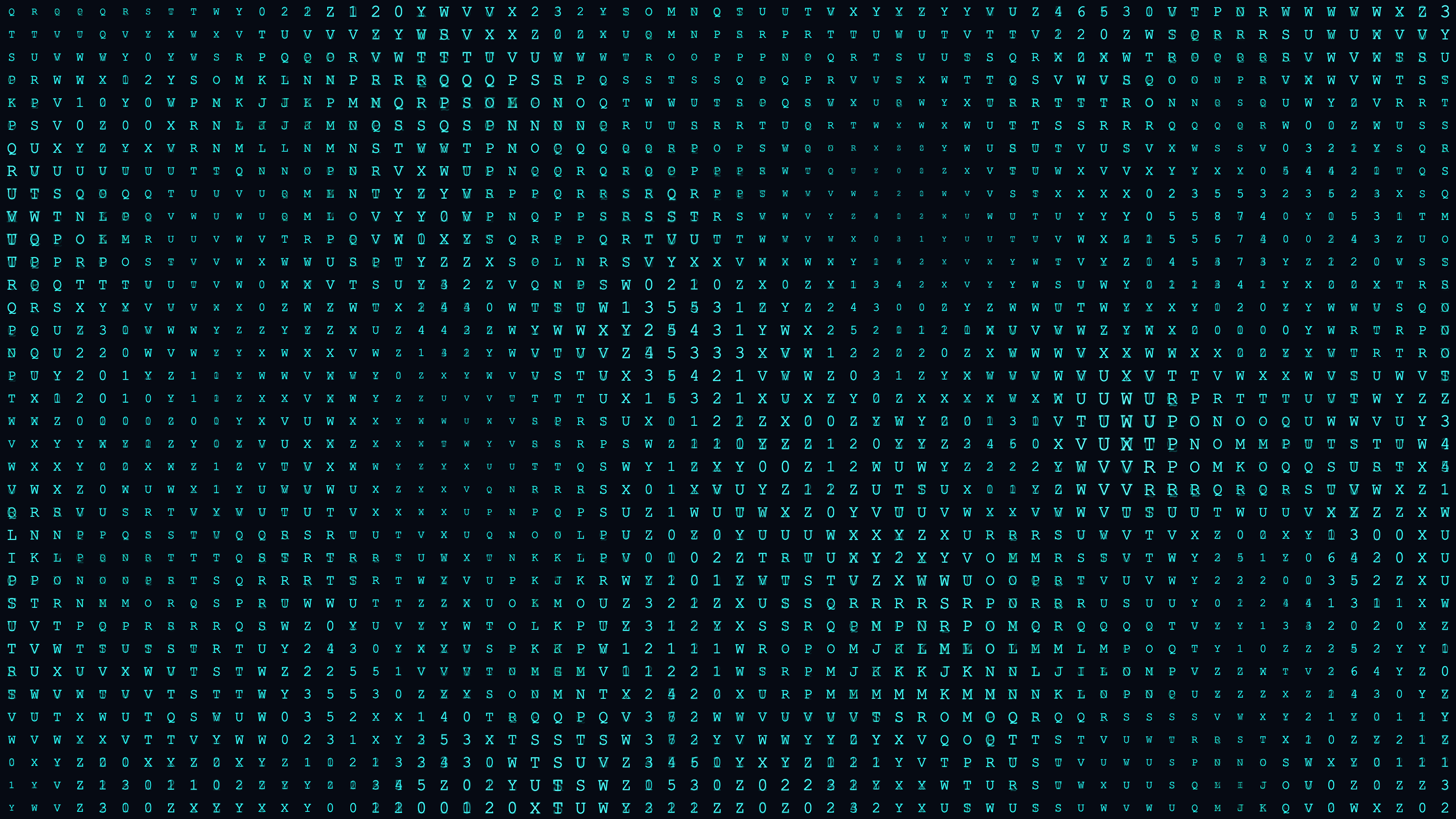
The core visual concept centers on a dense, structured grid that is constantly fighting against organic disruption. The base state of the simulation is a field of monospace typography, rendered in a cold, luminous spectrum of greens and cyans. This immediately establishes a recognizable, data-centric atmosphere.To elevate the piece beyond a simple terminal emulator, motion blur is introduced via a translucent frame clear. Instead of wiping the canvas entirely, a dark rectangle with a low alpha value (py5.fill(5, 10, 15, 60)) is drawn each frame. Combined with additive blending mode, this causes moving or scaling characters to leave ghosted trails, softening the harsh edges of the typography and simulating the phosphorescent persistence of vintage CRT monitors.The primary visual disruption comes from the procedural glitch mechanics. Rather than relying on random noise—which feels chaotic and unstructured—the glitches are driven by high-frequency Perlin noise. When a specific threshold is crossed, a cell undergoes a sudden, violent structural change. It snaps out of alignment, scales aggressively, and fractures into separated red and blue color channels, simulating chromatic aberration. This creates a compelling visual rhythm: smooth, undulating waves of data abruptly interrupted by harsh digital artifacts.Code & Technical Breakdown
The simulation is built around a single, highly optimized nested loop that iterates through the grid cells. Within this loop, multi-dimensional noise functions evaluate the state of each typographic element.Multi-Dimensional Noise Evaluation
The foundation of the animation lies in sampling the Perlin noise space. For every cell, characterized by its i (column) and j (row) coordinates, two distinct noise values are generated.time_t = py5.frame_count * 0.02
# ...
for i in range(cols):
for j in range(rows):
# ...
# Perlin noise for ripple and scale
n_scale = py5.noise(i * 0.1, j * 0.1, time_t * 0.5)
n_char = py5.noise(i * 0.2, j * 0.2, time_t * 0.2)
# Select character based on noise
char_idx = int(py5.remap(n_char, 0, 1, 0, len(CHARS)))
char_idx = py5.constrain(char_idx, 0, len(CHARS) - 1)
char = CHARS[char_idx]By passing time_t as the third parameter to the py5.noise() function, we sample a 2D slice of a 3D noise volume that moves steadily along the Z-axis. n_scale operates at a lower frequency (multiplier of 0.1), resulting in broad, sweeping waves that affect the size and brightness of the text. n_char operates at a slightly higher frequency, causing the characters themselves to cycle rapidly but organically, rather than flickering randomly.
The Procedural Glitch System
The glitch effect is not an overlay or a post-processing shader; it is embedded directly into the rendering logic of each individual cell. A third noise sample determines the probability of a glitch occurring at any given moment.# Glitch effect probability
glitch_chance = py5.noise(j * 0.5, time_t * 2.0)
is_glitch = glitch_chance > 0.85
if is_glitch:
x += random.uniform(-20, 20)
n_scale *= random.uniform(1.2, 1.8)Because glitch_chance uses a high frequency for the spatial coordinate (j * 0.5) and time (time_t * 2.0), the glitches appear as fast, horizontal tearing effects that whip across the screen. When is_glitch evaluates to true, the base position is violently offset, and the scale is magnified, breaking the rigidity of the grid.
Simulating Chromatic Aberration
To sell the digital malfunction aesthetically, the standard color rendering is bypassed during a glitch state in favor of simulated chromatic aberration.py5.push_matrix()
py5.translate(x, y)
py5.scale(scale)
base_alpha = int(py5.remap(n_scale, 0, 1, 50, 255))
if is_glitch:
# Chromatic aberration
py5.fill(255, 50, 50, base_alpha) # Red channel
py5.text(char, -4, 0)
py5.fill(50, 50, 255, base_alpha) # Blue channel
py5.text(char, 4, 0)
py5.fill(255, 255, 255, base_alpha)
else:
# Matrix green-cyan
r = int(py5.remap(n_scale, 0, 1, 0, 50))
g = int(py5.remap(n_scale, 0, 1, 150, 255))
b = int(py5.remap(n_char, 0, 1, 100, 255))
py5.fill(r, g, b, base_alpha)
py5.text(char, 0, 0)
py5.pop_matrix()Instead of rendering the character once, the glitched state renders it three times. The red and blue channels are manually shifted along the X-axis (-4 and 4 pixels respectively), mimicking the color fringing seen in distressed optics or failing video compression. The base white character is then drawn on top. Because the canvas is in additive blending mode, these overlapping colors merge intensely, creating bright, aggressive flashes that contrast sharply with the serene green data flow.